Infos
2024
Generative Composition: Interactive website for The Learning Garden, Courtesy of the Artist
Commissioned by the Diriyah Biennale Foundation for the Diriyah Contemporary Art Biennale 2024.
Curated by Rahul Gudipudi and Ute Meta Bauer.
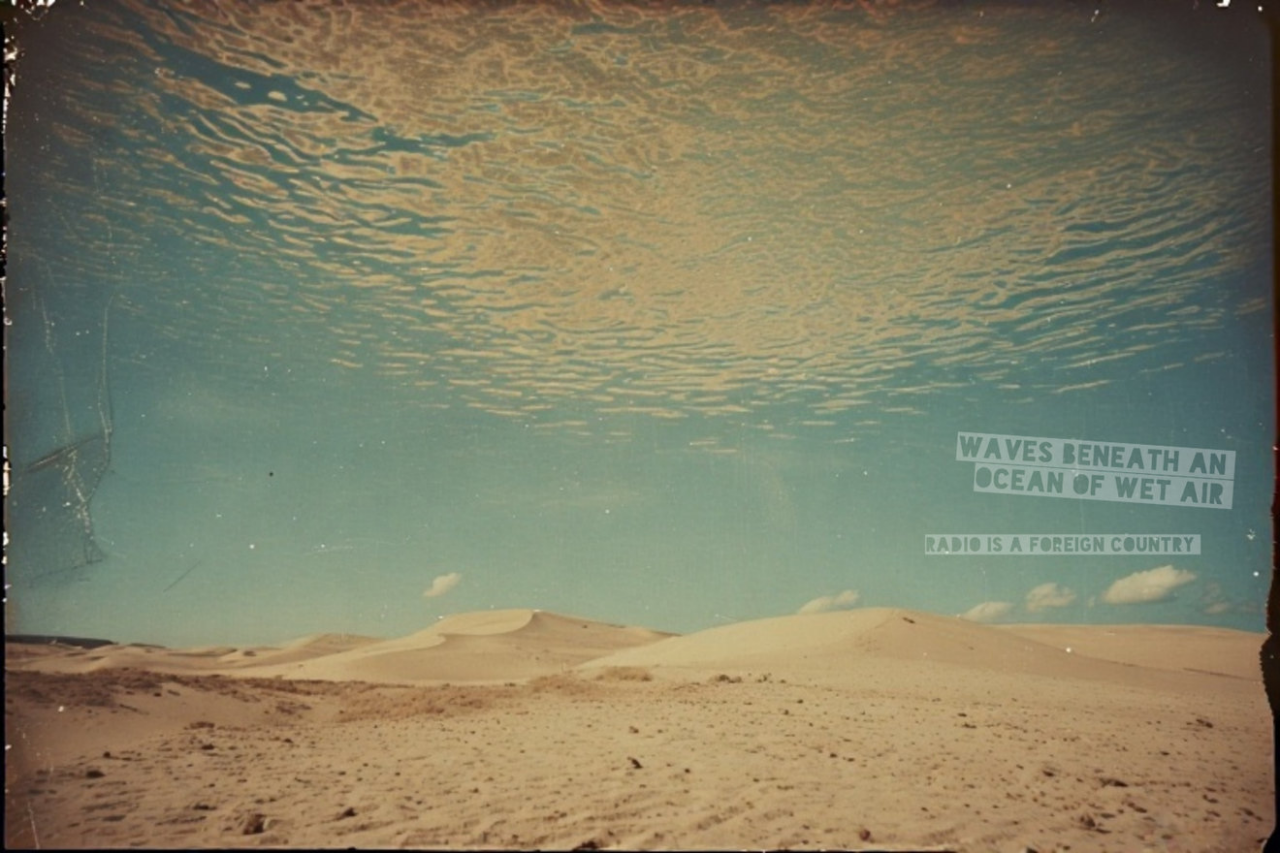
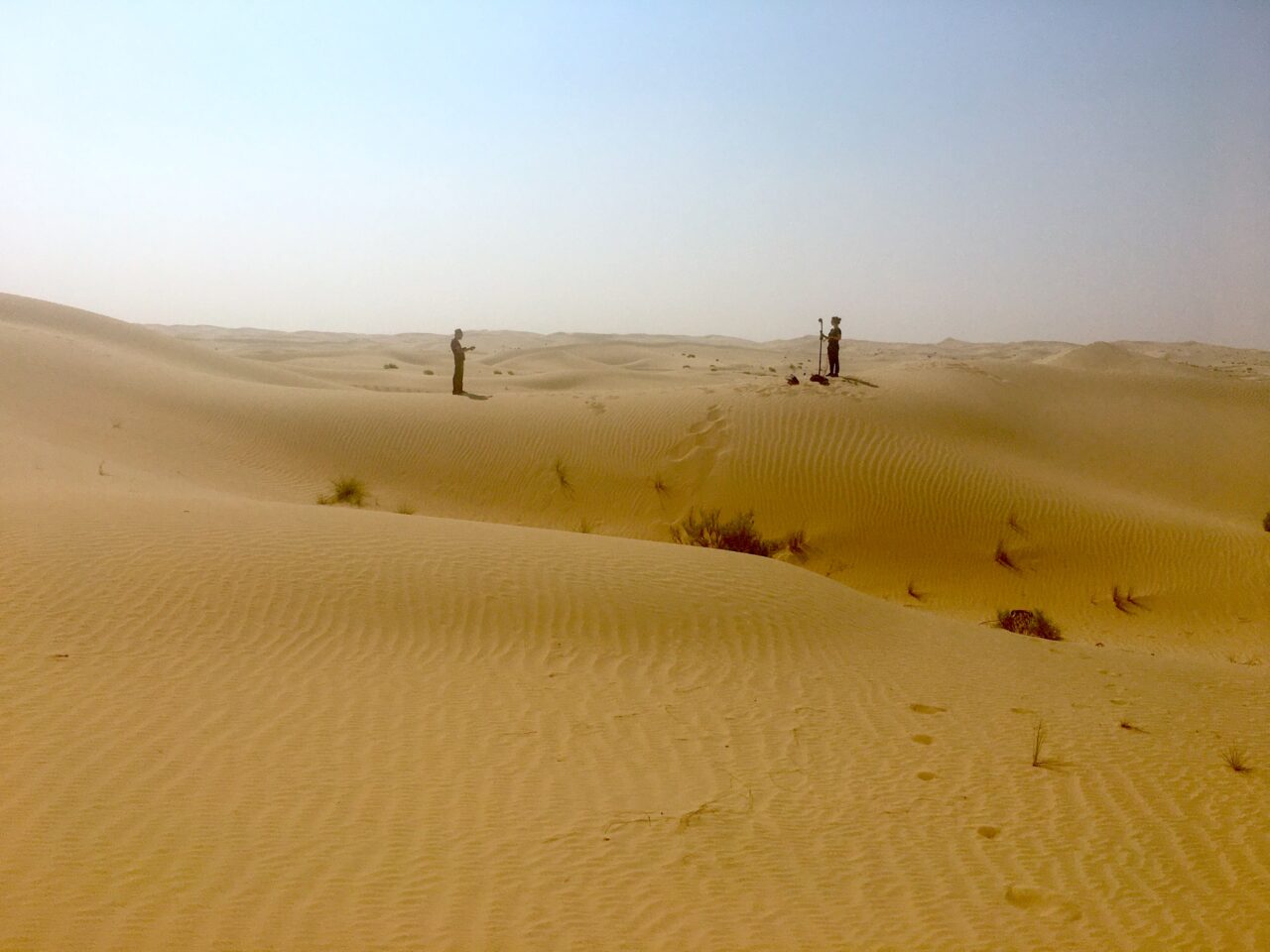
Waves beneath an ocean of wet air is an interactive musical composition in the form of seven radio stations that drift in and out of reception. A website invites listeners to explore an assembly of sounds collected over the years in deserts, oceans, cities and labs by tuning into its overlapping frequencies. In a sea of radio static this multitude of sounds coalesces around the strange hum of singing sands recorded in the Rub' al Khali desert.
Dunes take shape through repeated patterns of flow. Like musical rhythms these flows organise particles into undulating waves of barchans, stars, parabolas, domes and other forms. This occurs with wind in the desert, with water at the bottom of the sea, or ice on the shores of arctic beaches. In fact, physicists believe that the best way to study dune formation is underwater: a motorised tray immersed into a large basin moves a mound of sand rapidly through the water, displacing its grains like gusts of wind. Repeatedly moving the tray reveals a landscape of flowing dunes resembling an underwater desert.
Singing sands are a natural phenomenon where sand emits a sound akin to singing or humming when disturbed. This occurs due to a combination of factors: the shape, chemical composition and size of the sand grains, the humidity level, and the temperature of the sand. When disturbed by factors like wind or footsteps, the grains start sliding and rubbing against each other. This friction generates vibrations that propagate through the sand, causing neighboring grains to vibrate in harmony. As more grains synchronize their movements, they collectively produce the distinctive sound known as singing sands. The precise mechanism behind this synchronization, however, is still a subject of scientific investigation.
The chemical composition and shape of each sandgrain also speak of its migration through seabeds, mountains, cities, clouds and deserts. Some of the grains become construction materials for cities or get pumped into seabeds to create new land. This project aspires to weave a composition with sounds from oceans of varying wetness and with deserts in varying states of flow.
Waves beneath an ocean of wet air explores relationships between the desert and the gradients of wetness that surround, envelop and flow within it and its inhabitants. It seeks to reveal how earth and sand are fluids and how this resonates with Anuradha Mathur and Dilip da Cunha's deconstruction of sea vs. land as a dominant, colonial fiction
Video footage
- Centimetric underwater barchan dunes created in a laboratory experiment. Sylvain Courrech du Pont at Université Paris Cité.
Musicians
- Brice Catherin (cello),
- Anouk Chambaz (singing dunes),
- Anouck Genthon (violin),
- Mohammad Hussain Shaikh (horn),
- Chernoll Mendonca (clarinet),
- Anna-Kaisa Meklin (viola da gamba),
- Karim Rushdy (singing dunes),
- Gautam Sawant (tuba)
Sound mastering
- Clément Cerles
Graphic Design
- Backstore
- (Arthur Chaput, Lucas Lejeune)
Web Design
- Alan Woo
Research and documentation:
- Anouk Chambaz,
- Bastien Gallet,
- André Gwerder,
- Mathieu Lucas,
- Ivan Mata
Field Recordings
Singing Dunes
Madinat Zayed, UAE
- 23°25'19.9"N
- 53°33'57.6"E
Singing Dunes
Madinat Zayed, UAE
- 23°25'19.9"N
- 53°33'57.6"E
Foraging Cataglyphis “desert” ants
Al Wathbah, UAE
- 24°05'44.5"N
- 54°46'19.1"E
Foraging Eciton “army” ants
Gunma reserve, Brazil
- 1°12'03.2"S
- 48°17'45.2"W
Impulse response measurements
Al Wathbah, UAE
- 24°06'03.9"N
- 54°45'26.4"E
Sonified Dune Formation, digital simulation,
Physics department,
Paris Cité University, France
- 48°49'41.8"N
- 2°22'56.9"E
Sand flowing onto a suspended steel sheet,
Orléans, France
- 47°54'13.0"N
- 1°54'53.9"E
Beachfront
Colombo, Sri Lanka
- 6°51'27.1"N
- 79°51'36.3"E
Harmonium Improvisation on Lydian scale
Rio Cinema, Colombo, Sri Lanka
- 6°55'29.9"N
- 79°51'06.5"E
Underwater recordings
Hiriketya, Sri Lanka
- 5°57'33.7"N
- 80°42'13.8"E
Coral reef sound buoy, underwater recording
Okinawa, Japan
- 26°39'54.0"N
- 127°52'08.4"E
Radio Static
Ban Ban cemetery, Laos
- 19°38'38.2"N
- 103°33'52.9"E
Radio Static
Buttes Chaumont Park
Paris, France
- 48°52'48.9"N
- 2°23'05.8"E
Radio Static,
Al Wathbah Desert, UAE
- 24°07'49.3"N
- 54°44'12.5"E
Radio Static,
Hiriketya Beach, Sri Lanka
- 5°57'35.0"N
- 80°42'23.4"E
Riyadh web radios: 1 Malayali and Radio Asharq with Bloomberg,
Riyadh, Saudi Arabia
- 24°51'47.2"N
- 46°29'35.3"E
Electromagnetic interferences,
Bern, Switzerland
- 46°57'22.4"N
- 7°27'34.0"E
Electromagnetic particles from space hitting earth’s stratosphere,
somewhere above la Ferté-Bernard, France
- 48°10'36.9"N
- 0°37'30.6"E
Rat neurons action potentials,
ISPCI Paris, France
- 48°50'29.9"N
- 2°20'48.1"E
AI voice synthesis : Riyadh Asharq Bloomberg Radio,
Riyadh, Saudi Arabia,
- 24°51'47.2"N
- 46°29'35.3"E
AI voice synthesis : starling vocalisations,
Gentner Lab, San Diego, USA
- 32°52'56.4"N
- 117°14'04.3"W
AI voice synthesis : Sinhala Text-to-Speech Dataset Mrs. Oshadi - around 1000 voice clips.
San Diego, USA,
- 37°57'07.0"N
- 122°01'17.9"W
AI voice synthesis : percussion dataset,
IRCAM, Paris, France,
- 48°51'34.7"N
- 2°21'04.9"E
Ghost Travellers String trio, performing with flute carrier pigeons,
Belluard Festival, Switzerland,
- 46°47'06.3"N
- 7°16'07.5"E
Satellite Sonata, Brass improvisation, Story of Space,
Panaji, Goa, India
- 15°29'41.5"N
- 73°49'00.8"E
Buchla Easel Synthesizer,
Paris, France
- 48°52'43.1"N
- 2°23'13.6"E